Roll Your Own Rosling-​​esque Statistical Visualizations

It’s a sta­tis­tical cer­tainty that you watched Hans Rosling’s extra­or­di­nary infor­ma­tion visu­al­iza­tion pre­sen­ta­tion, from back when TED talks were cool. If not, you should cer­tainly watch it below, as well as all the tri­umphant sequels.

And now, courtesy of Google, an exper­i­mental inter­face for rolling your own Rosling-​​esque sta­tis­tical displays. Below is one of the examples they offer, slightly cus­tomized by me, but you can start from scratch and cook up anything you want from the datasets they have on hand.

The inter­face for assigning vari­ables to axes and sym­bolism is fan­tastic. It’s reminds me of the Hectares BC approach. (Which reminds me in turn of the won­derful and neglected JMP exploratory stats package.) Complicated inter­faces are great when you know what you want and want to be able to get it no matter how com­pli­cated it is, but a simpler inter­face allows for faster experimentation.

I hope they expand the amount of data, and I’m sure they will. I also hope they allow for cross-​​tabbing data from dis­parate data sets: for now you can only cor­re­late numbers from the World Development Indicators with other WDI numbers, for instance.

We’re increas­ingly seeing numer­ical and geo­graph­ical infor­ma­tion displays which explic­itly incor­po­rate time, and Google is a big part of that. I’m a big fan of that trend towards explicit tem­po­rality — it helps take the focus off stocks and onto flows, and makes casually it clear that base­lines really do shift.

Obama Appoints Edward Tufte to Increase Stimulus Transparency

Sounds kind of like an Onion headline. But also sounds like a good idea.

The stimulus and asso­ci­ated bank bailouts were almost cer­tainly absolutely nec­es­sary. We will never know, because we can’t run the exper­i­ment again. The imple­men­ta­tion of the American stimulus seems to have been mis­man­aged by some criteria. We should know about that, but it’s hard, because trans­parency is one of the criteria it seems to be failing on. Perhaps Tufte will help us with that.

Visualizing the New York Times, for Example

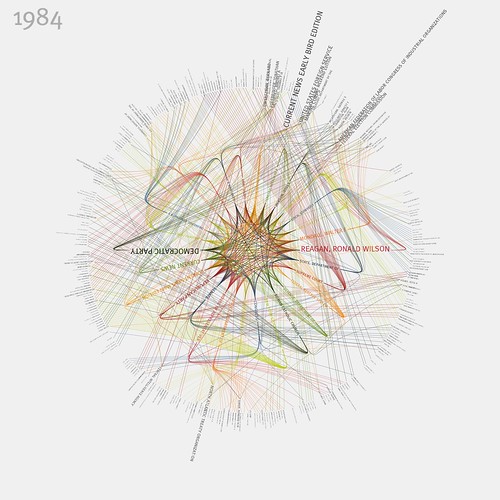
I wanted to post about these amazing visu­al­iza­tions of links between people and orga­ni­za­tions in the New York Times. But in the course of looking up their author I dis­cov­ered that almost every­thing he creates is that or more amazing, which makes it dif­fi­cult to choose one example to high­light. Nonetheless, here’s the 1984 version of the NYT viz:

NYTimes: 365/360 - 1984 (in color)

Check it out large, or see the whole set.

Jer Thorp appar­ently works by visu­al­izing the output of data mining executed on publicly avail­able data streams. He mostly uses Processing to do it, which he calls “an elec­tronic sketch­book for devel­oping ideas”. Interesting. Using infor­ma­tion tech­niques to digest and syn­er­gize the increasing amount of public (spatial) data sets is becoming a natural part of GIS, and if I were a more ambi­tious pro­grammer I might be inspired by this stuff to try and use Processing in a spatial context.

(Also, he appears to have good taste in neigh­bour­hoods.)