A Moderate Shift in Canadian Voting

The parties’ seat dis­tri­b­u­tion matters for the four years between elec­tions, and this past election gen­er­ated a sig­nif­i­cant shift in seats. The popular vote will also matters for those four years as the parties try to align their policies with their under­standing of the voters. After that comes the 2015 election, where seat dis­tri­b­u­tion will be mean­ing­less and popular vote will once again mean every­thing. So let’s not forget the popular vote in our col­lec­tive, well-​​justified con­ster­na­tion around seats.

Here’s the popular vote from 2008 and 2011:

These changes may have tipped a lot of first-​​past-​​the-​​post riding outcomes, but in them­selves they are moderate shifts.

I’ve read a few articles from a range of politicos stating or implying that Canadians must broadly support the Conservatives’ con­ser­v­a­tive politics, given that they “just won the election” (see here for a fresh example). Yes, but without the actual support of the actual majority of voters, and with little improve­ment over their last lukewarm endorse­ment. And if you believe the post-​​election focus-​​grouping, even the people who voted Conservative aren’t espe­cially moti­vated by con­ser­v­a­tivism. This will be a trying four years, par­lia­men­tary process being what it is. But the left won’t be any stronger through those years if it forgets that it rep­re­sents the sig­nif­i­cant majority of Canadians’ values. That’s not a trivial factoid, that’s a baseline fact.

And how about that “historic collapse” of the Liberal party? From 26% to 19%. A shift of one voter in 14.

If you follow the par­lia­men­tary trend over the last few years you could be forgiven for thinking that we’ve seen a entrench­ment of con­ser­v­a­tive values in Canadian politics, and now a massive re-​​arrangement of centre-​​left party politics. I think what we’ve seen is parties luffing their sails in the fickle winds of minority politics, some slight shift in Canadian voting, and very little shift in actual Canadian values. Those votes and those values are what will matter in the long run, even if the short run is a sorry mess.

See pre­vi­ously: Plus Ca Change

Half A Chance At A Centre-​​Left Coalition

It’s a ridicu­lous time for spec­u­la­tion, given that the one poll that really matters is actively underway, but I’m going to spec­u­late anyway. I’ve got four ifs and a hopeful then.

  • If Harper doesn’t get a majority.
  • If the NDP comes in number two.
  • If the NDP and the Liberals have more seats together than the Conservatives, without the help of the Bloc.
  • If the NDP cal­cu­late that the public opinion cost of spear­heading a coali­tion wouldn’t be too high.
  • Then we could have an NDP-​​led centre-​​left coali­tion within weeks.

I’d assign about 2/​3rds like­li­hood to the #1 if. The best two polling aggre­ga­tion and mod­el­ling sites are both pro­jecting 143 seats for the Cons, 12 short of a clear majority. Polling and mod­el­ling some­times gets it wrong, but not usually very wrong right before an election. Especially if multiple models are coa­lescing on the same projection.

#2 if is probably 2/​3rds likely as well. Even the more cautious three​hun​dredan​deight​.com is pro­jecting the NDPs in a strong second place. Given that the numbers were getting higher right up until the last poll left the field, that could mean that the final results could look even better.

#3 is hard to tell, but let’s say 12 chance. tooclos​e​to​call​.com says yes, three​hun​dredan​deight​.com says no.

#4 is probably 3/​4s likely. The Liberals made a choice to under­write Harper’s very effec­tive framing of coali­tions as back-​​room deals to elect second place leaders. They probably had to. But the NDP never bought that message, and they’re better placed to lead the charge on re-​​framing. And if they do form a rel­a­tively stable two-​​party sans-​​Bloc coali­tion, it would likely give them a full four years to prove to the sus­pi­cious Anglo masses that coali­tions are a boring, prac­tical arrangement.

I’m not sure how to boil those prob­a­bil­i­ties into a single math­e­mat­ical like­li­hood, because they’re all cor­re­lated with each other. But gen­er­ally I’d say we’ve got a one out of two chance of a won­derful outcome here.

The alter­na­tive could be terrible. Who says Canadian politics are boring? OK, nobody lately.

Also worth noting: the first major act of a re-​​elected Conservative party is pre­sum­ably to re-​​introduce the same budget that par­tially trig­gered the last dis­so­lu­tion. If a coali­tion is to be formed, that will be an obvious moment for it. If it happens, it could happen in a matter of weeks. Another wildcard: even if a coali­tion meant a second-​​place Liberal party very pub­li­cally going back on their word and allying them­selves with the nasty Bloc, they might still go for it. I’m not sure it would be stable or play well in the inevitable next election, but it would be hard to resist.

Oh boy.

A Lefty Website for Strategic Donation

Swing33​.ca links to the donation pages of 33 can­di­dates that could be key to the outcome of the upcoming election. The idea came from Mitch Anderson, who rents a desk beside the desk I rent, and who has an op-​​ed in the Tyee today explaining. I helped build it.

We’re not fans of the Harper admin­is­tra­tion, and we’d like to do some­thing to boost the prospects of the leftist (and centrist) Canadian parties. There’s 308 ridings in Canada, but not all of them are likely to switch sides in 2011. Of those that are in play, not all are being seri­ously con­tested by a Conservative can­di­date. We had a look at the results of the last election and spread­sheeted out the ones where Conservatives came close to winning or close to losing. There are 33 ridings where there was less than a 5% dif­fer­ence between the Conservative and the top non-​​Conservative can­di­date. That’s our list. If you’re going to donate to a polit­ical campaign (and Mitch argues there’s good reason to), then you might want want to target it at cam­paigns that are likely to decide the number of Conservative seats in the next par­lia­ment. That goals feels impor­tant right now.

We did simple-​​ish math to pick out those ridings, and it’s not a perfect system. We’re using recent history as a guide and history doesn’t sit still. We’ve already spotted a couple of dis­tricts where local con­di­tions have changed since 2008 such that the best con­tender probably isn’t the one Excel picked. Saanich — Gulf Islands is the most obvious to me. (Donate to the Greens there, not the Liberals like the site says.) A com­menter at the Tyee has already called out Esquimalt — Juan de Fuca as another flub.

We’re con­sid­ering aggre­gating that kind of local­ized knowl­edge, and/​or bringing in con­tem­po­rary polling data and pro­viding an alter­na­tive curated list. Time is the lim­i­ta­tion. In the meantime we didn’t want to make it any harder to under­stand what the site was about by adding excep­tions to our algo­rithmic approach.

In sum: if you or someone you know can be con­vinced to pony up some cash to help facil­i­tate a good outcome in this year’s election, Swing33 could provide some rea­son­able guidance for giving that donation the most impact. The Conservatives are far better fundraisers than any of their com­pe­ti­tion, so give it some thought. Links to the donation pages of 33 likely can­di­dates are just two clicks away.

Canadian Mining Is Hijacking Congo Debt Relief

July 15th: See below for an update

50 years ago today Congo DRC gained inde­pen­dence from Belgium. Since then the gov­ern­ment has taken on massive debt eagerly offered by rich northern nations and insti­tu­tions. Debt relief is held by some to be one of the most effec­tive actions avail­able to rich coun­tries to facil­i­tate improved gov­er­nance in the global south. To that end, the International Monetary Fund was about to forgive its sub­stan­tial portion of Congo’s debt, but that action is being actively blocked by a single country: Canada.

Why in the world would we do that? Apparently, we’re using debt for­give­ness as a bar­gaining tool to force Congo to re-​​activate the oper­ating license of a Canadian mining company. The company is called First Quantum, and the Congolese gov­ern­ment recently revoked their right to operate three expen­sive copper mines after a review of mining prac­tices. The mines are now being trans­ferred to another inter­na­tional mining group, Highwind Properties. The Harper admin­is­tra­tion pre­vi­ously made a similar move to prevent that transfer when the Paris Club of Congolese debt holders con­sid­ered aban­doning their debt.

At the G20/​G8 con­fer­ences, Prime Minister Harper claimed that the transfer of the oper­ating licenses violated the rule of law and is framing the blocking of debt relief as stand for orderly gov­er­nance. First Quantum has a dubious record in Congo. In 2000 a UN panel pointed out that inter­na­tional mineral devel­op­ment con­tributes directly to the brutal and ongoing conflict in Congo, and iden­ti­fied First Quantum as one of a group of com­pa­nies failing to abide by OECD stan­dards designed to lessen that conflict. Since then a Canadian-​​influenced second panel absolved First Quantum under a more lax set of criteria.

I don’t know much about how First Quantum cur­rently operates in the Congo, or how Highwind Properties would operate, or what the specific moti­va­tions of the Congolese offi­cials were who trans­ferred the mines from one to the other. But I do know that Canadian mining com­pa­nies have a bad record for envi­ron­mental and human-​​rights choices in devel­oping coun­tries, and the avail­able evidence suggests that First Quantum’s earlier Congolese oper­a­tions may have lived up to that rep­u­ta­tion. If First Quantum is indeed innocent of oper­a­tional abuses, then I don’t doubt Canada can pursue their cor­po­rate rights in any number of inter­na­tional trade nego­ti­a­tion venues. Blocking an effort at debt for­give­ness, in Congo DRC, on the Congolese 50th anniver­sary, in favour of a single Canadian mining cor­po­ra­tion, is a despi­cable move.

Update July 15th:

The IMF and World Bank went ahead with the debt relief program, with Canada abstaining from the vote. I wonder what the status of the Paris Club debt relief action is?

The decision comes despite oppo­si­tion from Canada, which abstained from voting over Congo’s expro­pri­a­tion of Canadian company First Quantum’s rights to one of the world’s largest copper mines.

The Canadian company has taken its case to the International Court of Arbitration in Paris, and Canada’s objec­tions had for months delayed announce­ment of the debt relief.”

But the World Bank and IMF announced Thursday — the day after Congo marked 50 years of inde­pen­dence from Belgium — that they will support $11.1 billion in relief under the program for heavily indebted poor coun­tries and $1.2 billion under a mul­ti­lat­eral debt relief initiative.

World Bank, IMF support $12.3 billion debt relief for Congo despite objec­tions from Canada, SF Examiner/​AP

Mayor David Miller On Behalf of Canada

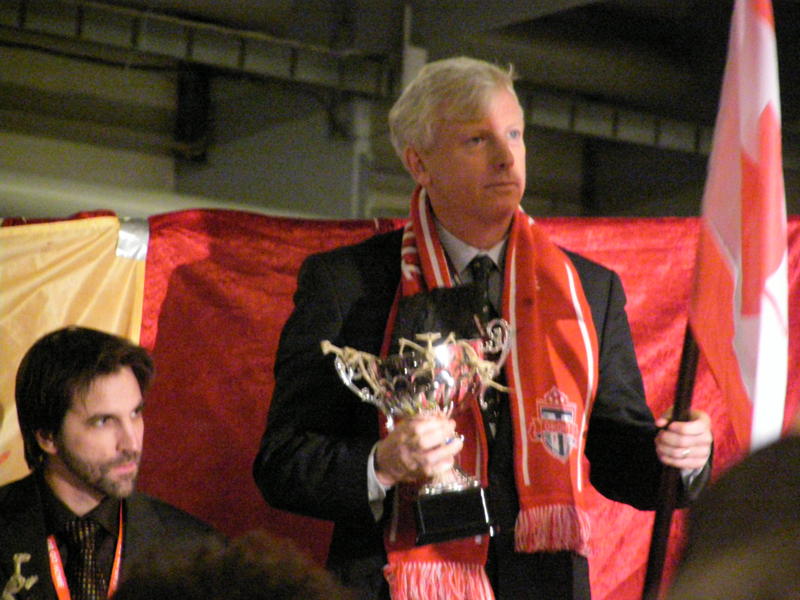
That’s Toronto mayor David Miller accepting two (!) Fossil of the Day awards on behalf of Canada today at the Copenhagen talks. Photo from friend Heidi, who is attending Copenhagen pro­moting a program on adap­ta­tion in Africa. Not every Canadian presence is about stalling col­lec­tive action. Go mayor Miller. Go Heidi.

Math-​​Checking the Carbon Pledges

President Obama today announced that he’ll be going to the Copenhagen climate talks, and that he’ll be taking an emis­sions cut pledge with him. That would be a 17% cut from 2005 levels by 2020. It’s great to hear a US leader setting quan­ti­ta­tive targets.

There are a few caveats:

  • the President doesn’t get to pass laws and congress hasn’t com­mitted, so it’s not clear how he can make a uni­lat­eral pledge
  • he’s going to the start of the talks, rather than the end, which is when all the rest of the leaders are supposed to hang out

I’m happy to look past those. Setting targets and filling in the details later beats nothing, and what the hell ever happens at leader’s photo-​​ops anyway? But there’s one more

  • that’s a 17% cut from 2005 levels

When coun­tries announce emis­sions reduc­tions, they almost always either baseline them against 1990, or some time in the last few years. If they pick 1990, it’s because they’re serious and they want to use the same standard that’s been in play since the days when the Kyoto Treaty was being for­mu­lated. Using 1990 means you can compare it against every­body else’s reduc­tion com­mit­ments, since they’re all using 1990 levels as well.

Except for that second group, who will use a recent year, like 2005 or 2006. Some time just long enough ago that emis­sions data is firmly on record, but recent enough that the pro­por­tional cal­cu­la­tion includes all the increases in emis­sions that have gone on since we were supposed to get serious about reduc­tions back in the ‘90s. Obama has chosen to be in that second group.

How about Canada? We’ve pledged (also without saying how we’re going to do it) 20% cuts from 2006 levels. Second group. Short bus.

Hard to sort out what all those numbers mean: 20% vs. 17% of two dif­ferent emis­sions levels, 1990 vs 2005 vs 2006. Luckily, Stephen Wolfram’s massive ego begot Wolfram Alpha for exactly this sort of operation.

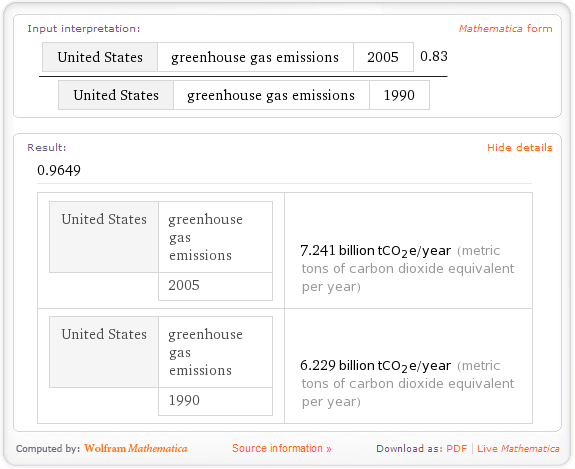
So, Wolfram Alpha, if the U.S. cut its green­house gas levels to 17% of what it emitted in 2005, what pro­por­tion of the amount emitted in 1990 would that be?

If Wolfram’s data is correct and the U.S. followed through on this current pledge, by 2020 the nation would be emitting 97% of the green­house gases released in 1990. That’s a 3% cut against 1990 levels, to compare with the 20 to 30% the European Union has pledged, for example. Keep in mind, by 1990 we had already realized that green­house gas levels were too high to maintain a stable climate. And by 2020 we will have had yet another decade of desta­bi­liza­tion. I’m still glad he’s setting targets, we may well need to take a few baby steps before we start walking some­where useful. But that’s not fully reas­suring, yet.

What about Canada? Environment Minister Jim Prentice is tickled that Canada and the U.S. are “har­mo­nizing” their responses, regard­less of their quality. He’s pointing out that the targets are oh-​​so-​​close to each other. Great! But if we want to use the 1900 baseline, just how close our targets are would depend on how we compare with regards to relative increase in emis­sions since then. Let’s check.

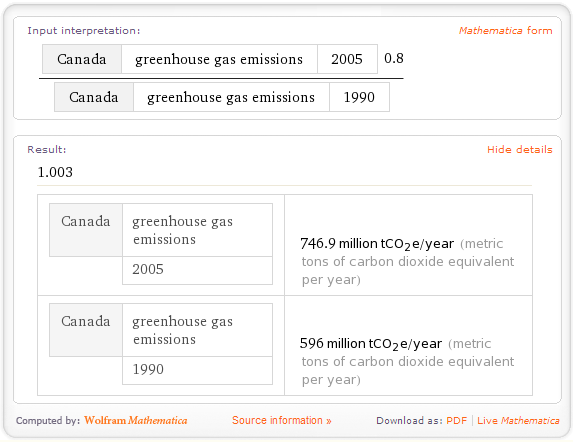
Unfortunately, Wolfram Alpha’s green­house emis­sions data only goes up to 2005, so we’ll have to fudge the Canadian cal­cu­la­tion a little and run it against 2005 data instead of the 2006 that the gov­ern­ment is using in their cal­cu­la­tions. That said, here goes:

That’s 100.3% of our 1990 emis­sions (assuming again that the data is correct). Very close to the U.S. com­mit­ment, yes. We’ve just very classily managed to commit to nudging our emis­sions com­mit­ment a teeny bit higher than the 1990 amounts that were scary back then.

Canada to World: Plan On Us Failing on Climate

The whole world is looking for lead­er­ship on climate change. Canada is being very clear on this subject: it ain’t us.

Climate change laws years away: Prentice — Nov 17th, CBC

Harper will only go to climate con­fer­ence if other leaders do: aides — Nov 15th, Canwest News

Canada can’t cut emis­sions in iso­la­tion from U.S.: Prentice — Nov 13th, Edmonton Journal

What Prentice and Harper have to say in the above articles is what every politi­cian wants to be able to get away with saying: we don’t want to be the first ones to move. We want to wait and see how things shake out before we commit our­selves. Lately Canada has been impres­sively vocal about our insis­tence on being on the wait-​​and-​​see team.

If everyone plays the game that way there will be no suf­fi­cient action taken, ever. What is needed is for a few players to decide that since there must even­tu­ally be a col­lec­tive response, they might as well just act as if it was hap­pening, and do some­thing brave with the con­fi­dence that they will even­tu­ally be backed up. To lead, as it were. Once some coun­tries are out front, then those that have been waiting to see what will happen can fall in behind. Presumably that leading action is going to come from rel­a­tively demo­c­ratic, uncor­rupt nations whose policy is meant to reflect the long-​​term will of the populace, and who by-​​the-​​way bare the greatest physical respon­si­bility for strip­ping everyone of a pre­dictable climate.

In other words, Canada should be leading. I guess we get points for being trans­parent about our complete failure to step up to that position. At least other coun­tries can plan ahead around our pending failure.

Tar Sands Day

There’s pro­testers occu­pying two dump trucks at the Albian plant, hanging a banner off Niagara Falls, and pick­eting the Canadian embassy in Washington. All this to cel­e­brate Prime Minister Harper’s visit to President Obama. Let’s hope this activity marks some kind of tipping point in con­ti­nental aware­ness of the tar sands and their special place in the canon of global-​​scale envi­ron­mental mistakes.

Here’s a couple of reasons why:

  1. Tar sands don’t threaten habitat, they replace it. They’re huge. Never mind for the moment the release of toxic byproduct into the Athabasca or the apparent increase in disease inci­dences in down­stream first nations towns, the tar sands are actually a hole in the surface of the earth. I would suggest looking at them in Google Earth, but the tar sands are also one of the few places on earth where the very topog­raphy of the planet is reshaped on a fast enough schedule that Google Earth’s ele­va­tion data is nec­es­sarily out of date.
  2. (and this is the big one) Tar sands is perhaps the most climate-​​destabilizing method of taking petro­leum out of the ground that humans have invented. It takes a lot of effort to get those hydro­carbon chains out of that greasy black gunk. Effort means energy. We put energy in to get the energy out. The exact figure of how many barrels of oil you get out for each barrel worth of energy you put in is hard to come by, pre­sum­ably because it’s so polit­i­cally fraught. Pembina insti­tute says the pro­duc­tion of tar sands crude dumps about 3 times as much carbon into the atmos­phere as other Canadian sources of oil, which is hardly a high standard. Oil prices will continue to climb as avail­ability shrinks, so burning up some non-​​renewable resources to get some more of them faster will continue to be an eco­nom­i­cally feasible trade-​​off (as long as we don’t require the petro com­pa­nies to cover the wider costs gen­er­ated from climate desta­bi­liza­tion). We have to decide for our­selves that envi­ron­men­tally, socially, this is not an accept­able trade-​​off. Today seems like a good day to make that call.

Write your gov­ern­ment! If you’re in Canada, Dogwood Initiative has some tools for you. In the States swing by Rainforest Action Network. Canada sells the tar sands as a polit­i­cally stable, domestic source of precious petro­leum. Let’s demon­strate that having domestic oil means that it isn’t polit­i­cally stable, because people here still have some say in how and when their dirt gets dug up.

A little Q&A:

Tar sands or oil sands? Kinda like note­books or laptops. If you’re in the industry or directly engaging with them you say oil sands, oth­er­wise you say tar sands. Both sound ugly and are.

What about the ducks? Yes, a whole bunch of ducks died when they landed on the giant tailings pond in the Aurora site, were coated in petro­leum by-​​product and sank. 500, oh no wait, 1606 of them. In fact, Syncrude picked today to plead not guilty in the court case, even as they apol­o­gize and re-​​iterate the un-​​acceptableness of the duck’s deaths and their firm com­mit­ment to pre­venting further loss of duck life. 1600 ducks is sad, but not the issue. The simple presence of the pit mines will have driven down the local pop­u­la­tion levels of of animal and plant com­mu­ni­ties by plenty more than 1600. Who knows what the tar sand’s con­tri­bu­tion to plan­e­tary climate de-​​stabilization will do to pop­u­la­tions of species world-​​wide. I think the thing about the ducks is that they’re a clear symbol of iden­ti­fi­able harm, so we’re all hung up on them.

Can you occupy a dump truck? Occupation is normally reserved for build­ings, it’s true. But these dump trucks are bigger than my house.

We’ve Chosen Not to Know What is Causing Salmon Decline

This is painful: It looks like we may not have the data needed to explain the pacific salmon collapse because of polit­i­cally moti­vated cuts to research, going back perhaps 30 years. It’s hard enough to under­stand ecosys­tems even when we have resources to do the science.

No answers in B.C.‘s sudden salmon collapse — Canadian Press, in the Globe and Mail

This has been a frus­trating tale for a long time now. The gov­ern­ment refuses to take on the research, dis­re­gards or even delib­er­ately inter­feres with non-​​gov sci­en­tists who try to do it on their own, and then dis­misses crit­i­cism from non-​​scientists by pointing out that there’s insuf­fi­cient sci­en­tific proof. It may be that fish farms aren’t to blame for this round of salmon decline, so it’s somewhat ironic that the media is picking this moment to wake up to the sea lice story. Of course there’s no knowing what the cause is either way. And now that the fish farms are well estab­lished and oceanic tem­per­a­tures and acidity levels are likely to remain unstable, it will be hard or impos­sible to set up well con­trolled exper­i­ments to find out.

John Cleese’s VHS-​​Era Pitch for Proportional Representation

In 4 days BC votes on the provin­cial gov­ern­ment, and more impor­tantly on whether to become the first major juris­dic­tion in North America to bring in a pro­por­tional rep­re­sen­ta­tion voting system.

I have the same worries about pro­por­tional rep­re­sen­ta­tion that I’ve always had — de-​​localizing politics, reducing the trans­parency and hence account­ability of the voting mech­a­nism. The Single Transferable Vote system proposed mit­i­gates the de-​​localization concern sub­stan­tially, but def­i­nitely makes my head hurt when I try to imagine how exactly a given set of marks on a ballot would trans­late into somebody getting elected or not.

That said, I still have the same hopes for a pro­por­tional rep­re­sen­ta­tion system: the de-​​dumbing-​​down of politics, elim­i­nating the lowest common denom­i­nator and forcing us to actively and openly nego­tiate multiple, openly expressed values to reach workable polit­ical com­pro­mise. Enfranchisement of non-​​centrist views, maybe even a general re-​​engagement with politics. First-​​past-​​the-​​post is just a ridicu­lous way to vote.

So I’ll be voting for STV with bells on. I’m looking forward to it. If you’re still on the fence, you could go to the pro-​​STV people and watch their videos, or the anti-​​STV campaign and watch theirs. But what I really rec­om­mend is to watch the video that first got me inter­ested in pro­por­tional rep­re­sen­ta­tion. Here it is: John Cleese on why 1980s Britain should really consider pro­por­tional representation.

Basically the same system, basi­cally the same con­ver­sa­tion, 20 years later. But I think this time we’re going to do it.

older posts →